

WHERE THOSE
WHO FEAR THE LAW BECOME LEGAL AFICIONADOS
The Legal Blog

EXPLORE BY CATEGORY
There’s a version of “legally protected” that feels true but isn’t. You have a contract, you send it before every project, clients sign it, and you move on. But having a contract and having a contract that actually works are two very different things. And most service providers don’t find out the difference until something […]

read the full post
SEARCH
looking for something specific?
There’s a version of “legally protected” that feels true but isn’t. You have a contract, you send it before every project, clients sign it, and you move on.
But having a contract and having a contract that actually works are two very different things. And most service providers don’t find out the difference until something goes wrong.
Erin Wilson is the founder of Design Ideal Consulting, a leadership development and training firm for teams and organizations, helping leaders and staff grow through strengths-based development, relationship intelligence, and practical tools that improve how people work together and lead.
But behind a growing, professional business was a legal foundation she wasn’t confident in. And that gap — between what her business looked like and what it could actually withstand — was costing her more than she realized.
The Real Problem Isn’t That You Have No Contracts. It’s That You’re Not Sure They’d Hold Up.
Before working with Taylored Legal Counsel, Erin wasn’t operating without agreements. She was operating with agreements she wasn’t sure she could enforce.
“I was worried about not having truly professional legal documents in place. I didn’t feel fully protected if a dispute or lawsuit ever came up, and that was stressful.”
That uncertainty is more common than people admit. And it creates a specific kind of background noise that follows you into every client interaction. The nagging question of what happens if this goes sideways?
For Erin, it also showed up as a practical problem: without clear, enforceable agreements, holding clients accountable felt murky. The language wasn’t tight enough. The terms weren’t specific enough. And because she hadn’t built them with a legal lens, she couldn’t know what was missing.
“It felt risky relying on informal agreements or patched-together templates, especially as my business grew. I wanted to protect my time, income, and reputation, but without solid legal structure, it felt like I was leaving too much to chance.”
Here’s what that actually costs you: decision fatigue at every client interaction. Energy spent second-guessing instead of delivering. And legal risk you can’t see until it’s too late.
The Misconception: Legal Is Complicated, So It Has to Be Hard
Most people who’ve had a bad legal experience (confusing, expensive, jargon-heavy) and assume that’s just what legal is. It’s not. That’s just what unclear legal is.
The difference with working with Taylored Legal Counsel, according to Erin, came down to one thing: actually understanding what she was signing and why.
“What surprised me most in a good way was how she explained the ‘why’ behind every decision. She didn’t just tell me what to sign, she helped me understand it.”
Instead of overwhelming intake forms or trying to translate dense legal language herself, the process was simple: a few Zoom calls, the right questions, and Erin’s answers turned into agreements that actually reflected how her business operates.
“Working together was easy and straightforward. The process felt organized, clear, and never overwhelming. I always knew what the next step was and what she needed from me.”
And when Erin had questions, complex concepts were broken down in plain language without the condescension that often comes with legal spaces.
“Compared to other attorneys I’ve worked with or talked to, you were much more approachable and educational. I never felt talked over or confused. I felt informed, confident, and empowered to make good decisions about my business.”
That’s what legal should feel like. Not intimidating, not confusing. Just clear.
What Changed: Fewer Headaches, More Confidence
After working together, Erin had something she hadn’t had before: agreements she was confident in sending to her clients, boundaries she felt confident in enforcing, and an overall sense of peace.
“After implementing everything, I felt real peace of mind knowing my business was finally protected. My contracts are clearer, smoother, and more professional, and I feel more confident working with clients. I worry less, sleep better, and know I’m not leaving my business exposed anymore.”
But the day-to-day win was more specific than peace of mind.
“The biggest win has been how smooth my service agreements are now. They’re clear, easy to use, and I get way fewer edit requests from clients, which saves me time and stress and makes the whole process feel effortless.”
Fewer edit requests sounds like a small thing, but it’s not.
Every time a client comes back with questions about a contract, you’re spending time in your inbox instead of in your work. Every time you’re not sure if you can enforce something, you’re making a judgment call you shouldn’t have to make. Every negotiation that happens after signing is a boundary that wasn’t set clearly enough before.
Clear contracts eliminate most of that. Not because clients become easier, but because expectations are set before anything goes wrong.
Legal Infrastructure That Grows With You
One of the most important things Erin said wasn’t about what changed immediately. It was about what the work set up for the future.
“This will support my growth by giving me a strong legal foundation that can scale with me. As I take on more clients and bigger opportunities, I know my agreements can handle it without constant changes. It lets me focus on growing my business instead of worrying about being protected.”
This is what proactive legal strategy actually does. It’s not just about solving today’s problem; it’s about building something that doesn’t have to be rebuilt every time your business grows.
“It didn’t just give me documents. It gave me confidence as a business owner. I feel supported, protected, and taken seriously, and that changes how I show up in my business.”
When you know your foundation is solid, you show up differently. You take on bigger clients, you charge what you’re worth, you enforce your agreements because you know they’ll hold up.
If You’re Not Sure Your Contracts Would Hold Up, That’s Worth Paying Attention To
You don’t have to be in a dispute to need solid legal agreements. By the time something goes wrong, you want the foundation already in place.
If you’re a service provider who’s been DIYing your contracts, using templates from the internet, or just hoping nothing comes up, it might be worth asking whether your agreements are actually protecting you, or just making it look like they are.
If you want to make sure your legal foundation is actually solid, start with a Legal Clarity Call here.
read the full post
THIS IS NOT A VISION BOARD — IT’S A LINE IN THE SAND
Legal is not a necessary evil. It is leverage. And if you don’t have it, you are operating at a disadvantage whether you realize it or not.
This is not a feel‑good brand statement. This is not aspirational fluff. This is not feminism as aesthetics.
This is a legal manifesto.
It is a declaration of how power actually works in business, why women are systematically denied access to it, and how legal strategy — when used intentionally — becomes the most underutilized leverage tool women founders have.
This manifesto is also an introduction to me, I’m Taylor.
WHO I AM
I’m a Texas business attorney with more than a decade of experience, an MBA, and a front‑row seat to what actually happens when smart, capable women try to scale inside systems that were never designed with them in mind.
I’ve watched women build seven‑figure value on six‑figure resources. I’ve watched them get talked down to, underpaid, over‑scrutinized, and told to be patient while their male counterparts were handed confidence and capital.
WHO I HELP
This is for ambitious female founders that…
- Are generating $75K–$500K in annual revenue
- Have outgrown DIY legal solutions but lack resources for big law representation
- Are scaling multi-revenue services or products / tech‑enabled businesses / monetizing your intellectual property
- And you are ready to stop the decision fatigue and emotional labor when it comes to legal and start building your bag (revenue).
And I’ve watched one thing change outcomes over and over again: being proactive with your legal strategy rather than reactive to a bad situation.
MY MISSION
To empower and equip female founders to build ambitious businesses with legal infrastructure and strategy that women in business haven’t had access to in the past.
MY VISION
To put more money in the pockets of women-led businesses because when women have money they tend to use it to make the world a better place.
WHAT I BELIEVE
Women don’t need permission to build wealth. They need systems that stop working against them.
Here is the belief most industries avoid because it makes people uncomfortable: The business world is not neutral.
It rewards confidence over competence, familiarity over fairness, and people who already know the rules over people who were never taught them.
Women don’t walk into legal spaces lacking ambition or intelligence. They walk in carrying:
- Social conditioning to be agreeable
- Fear of being perceived as difficult, emotional, or ignorant
- Disproportionate responsibility for teams, families, and dependents
Then the legal industry does something wild — it ignores all of that and pretends the playing field is level.
Shocker: it isn’t.
Despite owning nearly half of U.S. businesses, women‑only founding teams received roughly 2.3% of total venture capital funding in 2024, while male‑only teams received more than 80%.
Even when women secure funding, the checks are smaller. The scrutiny is higher. The margin for error is thinner. [NOTE: If you want to learn more about what the research actually says, you can do so here.]
This is not a confidence problem. It is a leverage problem. And leverage is built — not hoped for.
And here’s the part most people skip: Women cannot access real power in business without leverage. And leverage does not come from hustle, aesthetics, or goodwill.
It comes from understanding the rules of the game — and using them strategically.
Legal strategy is not a necessary evil. It is infrastructure.
It is what allows a business to survive pauses, seasons, illness, pivots, growth, and scaling without collapsing.
My desire for change is simple and radical:
Legal should work with women’s real lives — not punish them for having one.
Legal should empower, not intimidate. Protect, not shame. Expand, not restrict.
DOCTRINES
DOCTRINE 1:
WOMEN BUILD STRONGER FUTURES WHEN WE BUILD TOGETHER
Supporting women isn’t charity. It’s strategy.
Competition has never been women’s greatest advantage. Collaboration has.
When women share access, language, and knowledge:
- Information asymmetry shrinks
- Decision‑making improves
- Leverage becomes collective
This matters because autonomy is still rare for women — economically and structurally.
The myth of the lone, scrappy founder ignores reality. Women scale faster and safer when systems — legal systems included — are designed to support collective progress, not individual survival.
DOCTRINE 2:
KNOWLEDGE IS POWER — AND WITHHOLDING IT IS CONTROL
If legal feels confusing, that’s not accidental.
Legal systems are complex by design. Complexity protects incumbents. Confusion maintains hierarchy.
I don’t believe women are bad at business. I believe they were never given access to the rules in plain language.
Women deserve legal support that:
- Explains instead of obscures
- Educates instead of intimidates
- Treats questions as intelligence, not incompetence
Access to legal knowledge is not a luxury. It is a prerequisite for building a strategy and leverage.
DOCTRINE 3:
THE RULES WEREN’T WRITTEN FOR WOMEN
Let’s start with the uncomfortable truth most industries won’t say out loud:
Women don’t need more motivation. They don’t need louder affirmations. They don’t need permission.
They need systems that stop working against them.
I believe most people don’t hate lawyers because of bad outcomes. They hate lawyers because of how the process makes them feel: – small – confused – rushed – talked down to – ashamed for not already knowing the rules
And women feel this more acutely.
Women walk into legal and financial spaces already carrying: – social conditioning to be agreeable and “easy to work with” – fear of being perceived as difficult, emotional, or ignorant – responsibility not just for themselves, but for families, teams, and dependents
The legal industry largely ignores this reality — and then blames women when things go wrong.
DOCTRINE 4:
Education allows for strategy. Strategy is what creates leverage. Leverage builds wealth. And wealth creates choice, agency, and freedom.
EDUCATION ALLOWS FOR STRATEGY
A consultant scaling past $250K didn’t need “more hustle” — she needed contracts that clearly defined scope, IP ownership, and enforcement rights so growth didn’t increase risk.
Education is useless if it doesn’t translate into decisions and strategy.
If legal feels confusing, that’s not accidental.
Legal systems are complex by design. Complexity protects incumbents. Confusion maintains hierarchy.
I don’t believe women are bad at business. I believe they were never given access to the rules in plain language.
Women deserve legal support that:
- Explains instead of obscures
- Educates instead of intimidates
- Treats questions as intelligence, not incompetence
Access to legal knowledge is not a luxury. It is a prerequisite for building a strategy and leverage.
STRATEGY CREATES LEVERAGE
Legal infrastructure allows founders to step away, get sick, pivot, or pause without the business collapsing — because success that relies on constant output is fragile by design.
Confusion is expensive. Strategy compounds.
Most legal and business structures assume:
- Assertiveness without social penalty
- Emotional detachment without reputational risk
- Equal footing in negotiations
Women don’t get those assumptions.
Research shows gender bias in negotiation and communication — where identical behavior is interpreted differently based on gender.
So when women are told to “just negotiate harder” without legal strategy, they are being set up to fail.
Strategy changes the game. Strategy changes how you:
- Negotiate
- Enforce boundaries
- Price your work
- Protect your ideas
Legal Strategy is not paperwork. It is leverage.
LEVERAGE BUILDS WEALTH
I routinely see women who’ve signed five-figure agreements they couldn’t explain — not because they aren’t smart, but because no one explained the rules in plain language. With a strategy in place, those same founders turn into decisive negotiators.
Money is the outcome. Leverage is the mechanism.
Women receive less capital — but here’s the part that should make the system uncomfortable: Women‑led businesses often generate higher returns on investment when they do receive funding.
That’s not resilience. That’s efficiency. That’s strategy.
Leverage allows you to:
- Walk away from bad deals
- Demand better terms
- Protect what you create
- Scale without chaos
Legal strategy makes leverage repeatable.
WEALTH CREATES AGENCY
One founder running multiple revenue streams (services, digital products, affiliates) didn’t need separate lawyers — she needed a unified legal system that aligned contracts, licensing, and compliance across everything she sold.
Wealth is optionality. Optionality is power.
Wealth is not excess. It is safety. It is choice. It is the ability to make decisions without fear.
When women control their legal foundations, they control their outcomes. Not just in business — in life.
FRAMEWORK & SYSTEMS
Belief without structure is just inspiration. TLC exists to turn belief into repeatable legal systems.
Your legal strategy framework should keep you out of court, bad reviews offline and puts systems in place to solve client problems without emotional labor or decision fatigue.
Core Legal Frameworks
- Revenue-Protective Contract Systems: Contracts that scale with your business — not templates frozen in time.
- IP & Ownership Architecture: Treating ideas, content, and expertise as capital assets.
- Compliance Confidence Models: Replacing fear-based decisions with informed strategy.
- Negotiation Architecture: Using Strategy to increase leverage without requiring aggression.
These frameworks are designed to:
- Reduce decision fatigue;
- Eliminate ambiguity; and
- Support growth through seasons, pauses, and pivots.
EDUCATION
Education is not content. It is not motivation. It is not vibes. Education is how power transfers.
Clients are given just enough of an education so that female founders can strategize, build their business and monetize IP on their own – without overwhelm, extra training or becoming an attorney themselves.
Because education allows for strategy. Strategy is what creates leverage. Leverage builds wealth. And wealth creates choice, agency, and freedom.
TLC education focuses on:
- How legal strategy functions as business strategy
- How risk actually works (and how to manage it)
- How contracts, IP, and compliance impact revenue
- How to think like a founder with leverage
Generic education and advice isn’t provided here. This requires an attorney who knows online business models, common client vendors used [honeybook, Teachable, Skool, etc.], and how to implement legal into clients online assets. I teach you how to do the in-between-things like how to incorporate your new contract into your website, how to frame your offers to maximize revenue potential, or how to negotiate contracts with clients.
Education reduces emotional labor. Education creates confidence.
Once you understand the system, you stop fearing it. Once you stop fearing it, you can use it. Easy peasy, promise!
Legal strategy should not require a crisis to justify its existence. It should be built before the breaking point.
IF THIS RESONATES, START HERE
If you’re making real money and still feel exposed, overwhelmed, or unsure whether your business could withstand growth — that’s not a mindset issue.
It’s a systems gap.
The next step is not more content or motivation. It’s Strategy.
Start with a Legal Check-In or Strategic Review
Because power doesn’t come from knowing everything. It comes from knowing what matters — and building accordingly.
Legal strategy is not about avoiding risk. It’s about choosing power.
This manifesto is both a belief system and a warning: You can build without Strategy — but you will pay for it later. Or you can build with leverage.
This is what I believe. This is how I practice. This is Taylored Legal Counsel.
About Taylored Legal Counsel
Taylor Tomanka combines 10+ years of legal expertise with deep understanding of female founder challenges to create legal strategies that don’t just protect—they propel. Specializing in sophisticated legal architecture for scaling female entrepreneurs who refuse to think small.

read the full post
7 Secrets To Creating The Perfect Contract
Use these 7 secrets from a real, practicing attorney to create the perfect contract for your small business!
Tip #1 – Get The Contract In Writing
The first step is to get the contract in writing – always.
When you get the contract in writing you have physical proof that the contract exists. If you don’t get the contract in writing it may be hard for you to get a verbal contract enforced because there is no clear evidence of the offer, acceptance, and consideration.
The more practice you get writing out contracts, the better you will get creating the perfect contract.
Tip #2 – Utilize A Contract Template For Small Businesses
I have learned that it is always good to start off with a solid foundation when it comes to writing the perfect contract.
The second step is to know that you don’t have to handwrite every single contract. Instead, use a contract template for small businesses to help you with creating that perfect contract.
Need Useful LEGAL Terms? Here are 25 Terms for you to use
Business contract templates are created in advance and are added onto as different situations arise.
The best part about them is that you never start from scratch! All you have to do is make a copy of the template and then add in specific terms that relate to the transaction you’re drafting the contract for.
You can use the template as a checklist to make sure you’re not leaving out any critical contractual information and as a guide to ensure you’re protecting yourself in the same manner each and every time.
Tip # 3 Create A Contract Outline Before You Begin Writing The Contract
It is very – very important to always never miss any step in the contract writing process.
The third step is to have a solid outline for your contract before you fill in any information in the contract.
This is important because you want to ensure that you don’t leaving any information out of the contract that needs to be in the contract.
A typical contract outline looks like:
| Party Names |
| Recitals + Party Obligations |
| Payment Terms |
| Limitations Of Liability |
| Intellectual Property Protection |
| Legalities + Boilerplate Terms |
| Signatures Of Parties |
| Attachments (If Any) |
Tip #4 – Clearly Identify All Contract Parties
There are two main parties in a contract: Party A and Party B.
The fourth step is a very important one. You will want to clearly identify all parties in involved in the contract so that the right party is obligated or protected.
But who is Party A or B? A person or a company?
Who is signing on each party’s behalf and what is their role within their company?
Tip #5 – Include The Four Elements Of An Enforceable Business Contract
The fifth step is to ensure these four elements are included in your contract – this is a must!
| Elements Of A Contract |
| Element 1: Offer. |
| Element 2: Acceptance. |
| Element 3: Consideration. |
| Element 4: Mental Capacity. |
These four elements are the most important elements in a business contract.
Without an offer – there is no valid contract.
Without an acceptance – there is not valid contract.
Without a consideration – there is no valid contract.
If the parties are not mentally competent, there is no valid contract.
So, to create the perfect contract you must include all four of these elements.
Tip #6 – Don’t Be Afraid To Ask A Small Business Attorney For Help
Writing a contract can be confusing- and even complicated.
You need to know the laws governing the contract and you must know your final end goal for creating a contract in the first place.
You want to get things right the first time, so don’t be afraid to ask for help if contract writing isn’t your expertise.
You may have the idea, the end goal, but a small business attorney can help you create the perfect contract that you need for your small business, during the time that you need it.
As a women business owner, you already have a lot of small business tasks to juggle, right? Outsource Your Contracts To An Expert
Tip #7 – Read And Review The Final Contract Draft
Last, but not least: read and review.
Then, read and review the contract over again to check for accuracy to avoid any contractual writing mistakes.
Avoiding contractual writing mistakes comes with lots of practice, but practice makes perfect! When you conduct several contract reviews, you will lesson your chance at making contractional writing mistakes in your contract, in return, you’ll be well on your way to creating the perfect contract for you small business.

read the full post
6 Trends To Watch Out For In 2025
In 2023, there are a few things you need to be on the look out for.
This blog describes each of the six (6) biggest trends to pay attention to in the new year and how you can also make it legal!
1. Implementing A Subscription Service
Customers want a more interactive experience and a human touch added to their client journey. A subscription-first business starts with the purpose of servicing customers on an ongoing basis, which aligns the business and customer for the long term instead of speeding through a one-and-done transactional relationship.
However, just because you’ve started with a subscription model doesn’t mean that you can’t integrate transactional commerce too.
How To Prepare:
- Get to know potential clients & purchasing habits. Create your subscription products/service based on your research.
- Research the competition. Pay close attention to how they price similar products/services and how they market/promote their products/services.
- Develop your idea. Focus on thinking about the logistics and operational processes.
- Come up with a pricing strategy. Don’t forget to build in a good profit margin.
- Create a Marketing Plan. How will you market, advertise and promote your subscription product/service?
- Assemble a sample box/test your subscription online. Always be testing. If you are flexible to your audiences needs and desires, you’;l be more successful.
- Post-launch analysis. How did the launch go? Well? Great! Write your whole strategy down so you can repeat it again.
Let’s Make It Legal:
2. E-Commerce Mobile In-App Shops & Free Shipping
Customers have become used to shopping online and getting free shipping, so much so that they are starting to expect it. 28% of Gen Z have purchased a product through an in-app store and 71% say that they discover products on social media most often.
How To Prepare:
- Offer free shipping for your small business in one of these ways:
- Free shipping on orders of a certain amount (great way to incentivize consumers to build their shopping carts);
- Free local shipping;
- Free shipping for subscribing to your email list;
- Free local delivery;
- Free shipping during certain parts of the year;
- Free shipping on returns; or
- Free shipping for watching until the end of a video tutorial or promo.
Let’s Make It Legal:
3. Influencer Marketing
Influencer marketing is still on the rise. You may not be able to get Kim Kardashian to endorse your product or service, but you can get a micro-influencer (someone under 10k followers). Audiences rely on influencers for recommendations, and small business owners need to connect with engaged audiences that want their products or services. A third of Gen Zers have bought an influencer-recommended product and 71% say that they discover products on social media most often.
How To Prepare:
- Don’t waste your product, service or free shipping on someone without vetting them first. When evaluating an influencer for your business, consider their:
- Reach. How many people will they be able to reach with their message?
- Engagement. Do their fans interact with their posts?
- Relevance. Is their audience relevant to your business?
- Authenticity. Is the influencer authentic? What does your product or service mean to them? Are they promoting something similar?
Create a Facebook Group just for your influencers and post updates, codes, promotions, graphics, guidelines and more in one location. No more individual emailing!
Let’s Make It Legal:
4. Challenges With Hiring Talented Employees
Employee retention rates have plummeted over 2021 and the trend is expected to continue into 2025, unfortunately.
How To Prepare:
Interview Smart and make sure you do the following during the hiring process:
Identify the skills and characteristics that make a candidate a good match for your organization and each role, including any criteria that would help you reach a bigger talent pool. For instance, do you need employees on-site during regular business hours, or can you provide a flexible arrangement?
The messaging you share in your job descriptions and on social media about what it means to be an employee at your company. That is part of your value proposition as an employer, which helps candidates determine whether you might be right for them.
Your system for tracking and communicating with hiring managers and candidates during talent acquisition.
The talent sourcing strategies used for finding and attracting applicants (which ideally will include reaching out to former employees).
How you conduct interviews.
Your system for developing offers and navigating negotiations.
Invest in keeping and motivating the employees you have today by thinking through every step in the talent life cycle, including: acquisition, performance management, learning and development, succession planning, leadership development, and rewards and compensation. Identify those areas where you can improve, then prioritize.
Define And Cultivate A Great Work Culture. When I saw Work “culture,” I mean the beliefs, values, and norms considered acceptable at your company and how they influence how you behave with candidates, employees, clients, and partners. Exploring your workplace culture and existing mechanisms helps us understand what it takes to fit into your environment and succeed at your company. It also helps us see the roadblocks and how we can optimize your current workforce while developing a talent pipeline.
Let’s Make It Legal:
5. Personalized, Interactive Customer Service
What people are really craving is empathy and feeling like they’re speaking with a human.
How To Prepare:
Short-Form Videos: Social media accounts such as these are free platforms for you to highlight your business and what it offers. Think about making product tutorials or short videos that answer frequently asked questions. Post these on your social media platforms, but house them on your website. You can build these videos into larger segments, paid tutorials or build a subscription service with a library full of video tutorials!
VIP Days: For the ultimate interactive client experience, host a VIP Day and cater to just one client for the day. Your target audience will be willing to pay for this high ticket offer and you’ll be satisfying their desire for a custom, personalized client experience.
Build A Subscription Service.
Let’s Make It Legal:
- Custom Terms & Conditions + Privacy Policy
- Custom Contract
- Custom Subscription Terms & Conditions, Disclaimers + Privacy Policy
6. Strategic Partnerships
It’s going to be a good idea for you to start networking with non-competing, but related, businesses to help spread the word about each other’s services. You are six degrees from a potential business partner or contact who can change the trajectory of your business. The problem is that you don’t know the other five people between you and them.
How To Prepare:
Do you follow others in your industry on social media that don’t necessarily compete with your business? If not, you should start. For example, I just recorded this video with Pam Holt of The Happy Host Academy, a lawyer turned real estate guru who wanted her audience of all-female airbnb rental businesses (or soon-to-be) to learn about the basics of starting their business: business entity choices, business entity structure, legal pitfalls to avoid as you start out, etc. I was also invited into her paid program for free to connect with her community, answer questions, and hopefully build some leads!
I thought Pam’s cold DM was perfect:
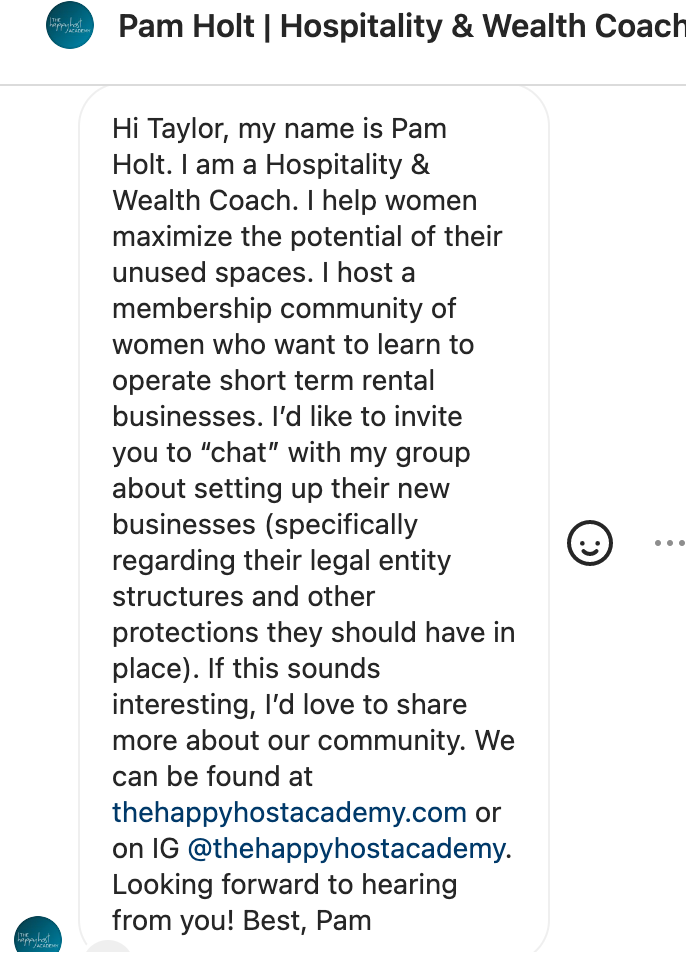
Taylor also has a podcast coming out with Chiron Consulting in early 2023 on the same topic, but we go into more detail. We’ll let you know when it’s ready!
Let’s Make It Legal:

read the full post
Most new business owners choose to form an LLC as their entity structure because it’s flexible and easy to create and manage. It’s actually my go-to entity structure for new business owners as well because of its ability to combine the pass-through-taxation aspect of a partnership, DBA or sole prop, with the limited liability protection of a corporation.
So, for that reason I’m just going to discuss everything in this blog from the perspective of an LLC owner.
If you own a business, you know that looking back at the past year to see what went right/wrong and where new opportunities for growth lie, and planning ahead is the best thing you can do to ensure your business will grow in the year to come.
In this blog post, I’m going over how to do just that (and hopefully ease some of your tensions) in just five (5) completely doable steps.
So, how do we begin the year off on the right foot? Well a big portion of the process is auditing and information gathering (groan, I know…) where you are in your business right now, your key metrics, operational systems & processes, team hiring, training and retention policies, client journey process, business finances, etc.
Only after this step is completed can you really see how you are able to go from where you are now, to where you want to be and then you develop a plan to get there. It’s easy to skip this step and move onto the planning part, but I urge you to take the auditing process and information gathering process seriously.
You can’t change where you’re going, without first knowing where you are.
So, be sure to set aside some real time to accomplish the five steps discussed below. Maybe that means you need to save this blog for later, print it out, Pin it, whatever you need to do – do it now.
And just remember – the work you put in and strategies you implement NOW will be directly reflected in your sales in 2025 & beyond. So, grab that extra cup of coffee, put on your big girl pants, and get grinding!!
5 Steps To Prep For Business Growth In 2025
- Update Your Contracts
- Audit Processes + Client Journey
- Get Your Finances In Order
- Outsource + Delegate
- Develop 2023 Biz Plan & Goals
1. Update Your Contracts
Each year, you should take a look at your existing contract template that you use for each of your Client services and make any necessary changes.
But, how do you know what to update?
The best way to know what to change in your contract is to go through your list of client’s for the year and recount if you had any issues or confusions with each client. If you did, write that issue down.
These issues are areas that need improvement or clarification in your contract.
For example, if you had a client or two request a million and one revisions 90+ days after the projections completion, you need to tight up your revisions process and terms within your contract.
If you rent your products out and some of them have come back damaged, you need to incorporate damage fees and replacement expenses in your contract.
Does all of this sound overwhelming to you?
Maybe you just don’t have the time.
Set up your free Discovery Call and let’s chat about my done-for-you legal solutions – Contract Amendment services and Customized Contract services!
2. Audit Processes + Client Experience
Once a year, it is vital for business’ growth to do a complete audit of your Client Experience Process as well as your business’ operational processes, systems and procedures.
This will not only ensure that you provide the best client experience possible, year after year, it will help you streamline operational procedures and cut unnecessary expenses.
Client Experience Process:
If you don’t have a client experience process in place, I highly recommend you take the time to map one out and start steps to implementing it into your 2023 services. Without an experience process in place, it is not only confusing and frustrating for your clients, it also makes everything much harder on your team.
There are four (4) main stages of the Client Journey for you to audit:
- Inquiry Stage: This stage involves the initial discovery call or consultation as well as the proposal that follows. Knowing exactly how to present your business in an elevated way from the first interaction will make you feel more confident, clients will see your value and the investment conversation will be much easier.
- Onboarding Stage: Start this stage off right by sending a welcome email and letting your client know what to expect. Maybe this looks like asking for client homework/feedback or providing a timeline of your service’s process.
- Fulfillment Stage: This is the stage of you actually performing your services for the client, through the final step in your client service process.
- Off Boarding Stage: The service has been completed and now you need a way to send your client off into the night (with a few party favors). This includes things like off boarding emails, wrap-up gifts, photoshoots of the final look, etc. In your off boarding email, consider including the following:
- Provide any post project resources clients might need;
- Collect feedback + improve the process based on what clients say or when patterns arise; +
- See where things went well and what clients loved and then ramp that up when necessary.
Systems & Processes:
A business system or process is an activity or set of activities that will accomplish a specific organizational goal.
These may be composed of Step-by-step processes, Client Instructions, Template Emails, Scripts, Checklists, Agendas, etc.
Leadership, Operational, Marketing, Customer, People, Finance, Administration are some typical systems & processes that small businesses may have, but your unique business may have more or less than those listed. It will just depend on your specific business industry and/or niche.
When auditing your business systems and processes, use these 6 questions to keep you on track:
- What do you actually need to run your business?
- Where are there gaps? Who/what will fill in those gaps?
- Have you already fully utilized the systems or software you already invested in?
- Can you afford these changes?
- What do you have time for? If you invest in something (a program, course, workshop) do you have the time to do it wholeheartedly?
- Do you have the time to implement and apply the system or software you are using or want to implement?
3. Get Your Taxes In Order
If you don’t already have your taxes in order or you typically have a “messy” time with taxes – keep reading! This is for you.
One of the bigger perks of owning a business are the different types of tax deductions you can use to lower your yearly taxes. But, first you need to have a basic understanding of how your entity is taxed in order to get the most out of it.
LLCs use what’s called “pass through” taxation in order to assess federal and state taxes. What this means is that income passes through from the business to the businesses owners, thereby limiting the amount of times the owner is taxed on that income.
For example, owners of a corporation are taxed twice. Once as the Corporation itself and once again on the income they derive from the Corporation as owners. An LLC owner, however, is only taxed once since the income flows from the one (the business) to the other (the owner).
Great, right?!
The LLC owner must also pay self-employment taxes (Social Security and Medicare) on all taxable income from the business, which is why claiming all of the tax deductions you can is so important. Every penny counts!
Want More? Here Are 10 More Deductions For Freelancers: 25 Tax Deductions For Freelancers
4. Outsource + Delegate
There are certain tasks that no one can handle on their own. This may be due to a lack of training or education or simply because you’re too busy. What does your normal day look like? What bogs you down during the work week? These questions should help you establish where you spend the most amount of time – see if you can delegate any of those tasks.
Why delegate? Because in order to grow, you have to start handing off certain tasks that can be done by others while you focus on your mission and high-level governance issues so that you can grow!
But, how DO you decide which tasks to delegate? Easy, you can do so in 3 steps!
- Track Your Time. You won’t know what tasks to delegate if you don’t first know HOW you actually spend your time. Track everything you do from emails, accounting/payroll, product inventory, etc. during the day, every day for a week. And in anything you can think of that you do on a bi-weekly, monthly & yearly basis and add to the list of tasks.
- Organize & Categorize Time. Take all of that time you wrote down for the past week (plus your bi-weekly/monthly/yearly tasks) and write out categories to sort the tasks into. Categories can include: accounting/payroll, administrative, product/service-related, etc.
- Analyze Your Time. Now that your daily, weekly, bi-weekly, monthly & yearly tasks are organized and sorted, analyze each category/task and ask yourself:
- What is taking up the most time in your business?
- Which tasks do you love doing?
- Which tasks feel like they drain you?
- Which tasks are revenue-generating?
- Which tasks do you not need to do yourself?
From there, you can decide what tasks you want to hand off to a staff member and what tasks to keep for yourself. Be sure to keep sensitive information and secure items out of reach (at least for a while!) for new employees. You don’t want someone working for you for 4 weeks and having full access to your fully online business.
Hiring. When you do hire someone you need to have a list of their duties already written out and ready for them on day 1. You can make this up from your organized list you made in steps 1-3 above.
Be sure to pick people with specific skills that you don’t already have. For example, if you need help with bookkeeping and accounting, then find someone with an accounting background.

read the full post


